

The Art of Erté
Erté was the professional name of Romain de Tirtoff (1892–1990), a Russian-born French artist known for his fashion design and illustration. Most of the illustrations below are costume designs, but they look like they could be on the cover of a fashion magazine. You can find even M.S. Rau Erté collection.
Erté’s illustrations are aristocratically erotic. Plenty of nude and topless women, but in an elegant way, not a raunchy way. If you compare it against pin-up artists like Shane Glines, you’ll see what I mean. Part of it is the way they’re posed, but it’s also where he draws the eye. The figures are drawn simply, while the fashion is big, vibrant, and detailed, pulling the gaze away from the nudity and towards what little clothes the women wear. That makes sense. After all, these are costume designs.
I’m a big fan of ligne claire, and this art style has a similar sort of feel to it, but with more Art Deco, glamour, fashion, fairy tale, and cabaret.
Illustrations
Les fleurs du mal

Erté, Les fleurs du mal. “The Flowers of Evil.” The title invokes Baudelaire’s Les Fleurs du mal. Makes me think of the Uth Duna armour set from Monster Hunter Wilds. Similar colours and flow. Same topless design. It makes me wonder if the guys making Monster Hunter were inspired by this illustration.
I also like how Erté rendered those pink pearls. They’ve got a nice colour and shine to them.
Betty

Erté, Betty. Is this a Caribbean sort of costume? Looks like she has snakes for earrings and an unusually alert crotch. Cool how he’s merged the legs, tapering them down into a single foot. I like the illustration quite a lot, but I worry the costume would tickle my butt.
Lydia

Erté, Lydia. Another nude with eyes on the crotch, but this time with an insect theme.
Les perroquets verts

Erté, Les perroquets verts. Green parrots. No eyes on the crotch.
Grand ara bleu et jaune

Erté, Grand ara bleu et jaune. Blue-and-yellow macaws.
La Nouvelle Angleterre

Erté, La Nouvelle Angleterre, 1952 (“New England”). The nude figure is delicate, but the mantle around her is huge and heraldic, guarded by a lion and a unicorn. It makes her look vulnerable and sovereign at the same time. Erotic in a classy and medieval way, but with a futuristic feel to it.
Maskenball Veneziani

Erté, Maskenball Veneziani. A Venetian masquerade costume that makes me think of a fairy tale or tarot card. I love looking at how different artists render sheer fabrics. Erté did a nice job of it.
L’Ange (1943)

Erté, L’Ange, 1943 (“The Angel”). A costume design for the Parisian music hall Bal Tabarin. Fewer breasts than usual. Indeed, the body almost disappears inside a vertical architecture of blue candles, feathers, and veils.
Balthasar (1919)

Erté, Balthasar, 1919. One of Erté’s theatrical costume designs: a biblical king reduced to a few immense shapes. I love how heavy the black is. It looks like he’s about to be swallowed by the void.
Les souris

Erté, Les souris (“The Mice”). Very much a pin-up illustration, and yet she appears to have gotten her hand caught in a mousetrap while trying to reach for pearls? I’m not quite sure what’s going on here. I like it, though.
Ce n’est que votre main, Madame

Erté, Ce n’est que votre main, Madame. The title means “It is only your hand, Madame.” They wear skirts made of gloves, as if they’re being groped. And yet, somehow, it still feels glamorous. I wonder if this is how guys like Weinstein imagined themselves—as glamorous gropers.
Une étoile de Hollywood


Erté, Une étoile de Hollywood, I, II, and III. A star of Hollywood. Makes me think of brown clamshells with thong sandals, but that can’t be right. Has the vibe of an epic Wagner opera, with horned vikings and valkyries.
Le cinéma cochon

Erté, Le cinéma cochon. An elegant costume built from strips of film, but the film is about a pig.
L’Oubliée

Erté, L’Oubliée (“The Forgotten Woman”). A pale, solitary figure wrapped in a jeweled gray-and-white cape. The title gives the image its melancholy: she is the woman everyone has forgotten.
Le roi de Lahore (1919)

Erté, Le roi de Lahore, 1919. A theatrical design for the King of Lahore. I love the red gemstones on his rings and hat.
Mistinguett (1917)

Erté, Mistinguett, 1917. A costume design for Mistinguett, the great French music-hall star. Strange haircut. Very punk. Makes me think of Ethan Suplee in The Butterfly Effect.
Final Chorus for Collection de Minuit

Erté, Final Chorus for Collection de Minuit. Collection de Minuit means “Midnight Collection.” A finale costume for Collection de Minuit. Makes me think of a peacock. A lot of these designs make me think of peacocks.
Cheveux noirs

Erté, Cheveux noirs. Black hair. And her black hair is the entire costume. She’s completely nude, with a big curly bush on her crotch. And yet, somehow, she still feels sophisticated.
Collection de Minuit Boy

Erté, Collection de Minuit Boy. Collection de Minuit means “Midnight Collection.” A male counterpart from Collection de Minuit. Strange bodysuit, but it flows nicely.
Les chaines

Erté, Les chaines (“The Chains”). The woman is chained naked, with arms forced wide, exposing her breasts. It should feel raunchy, but it doesn’t really.
Décor: La Reine Margot

Erté, Décor: La Reine Margot (“Set: Queen Margot”). A stage design rather than a costume. I love the heavy black, the rich blue, and the checkered floor. Comes together well.
Myla

Erté, Myla. I almost didn’t include this one. A little dull compared to the others. But it’s interesting to see how he simplified the folds of the fabric.
Les Écossais

Erté, Les Écossais (“The Scots”). Erté, Les Écossais. Makes me think of a Scottish warrior mixed with a royal schoolgirl.
L’Esclave porteuse d’éventail (1919)

Erté, L’Esclave porteuse d’éventail, 1919. A theatrical design for a fan-bearing enslaved attendant. Reminds me of Yoshitaka Amano’s Final Fantasy concept art.
Les jeux

Erté, Les jeux (“The Games”). A Mah-Jongg-inspired costume.
Le Carnet de Bal

Erté, Le Carnet de Bal (“The Dance Card”). This one makes me think of those sinister parties in Eyes Wide Shut.
Le poker

Erté, Le poker. Playing cards become a queenly white mantle, with the red and black suits doing the work of jewels and heraldry.
Chanteur for Raspoutine
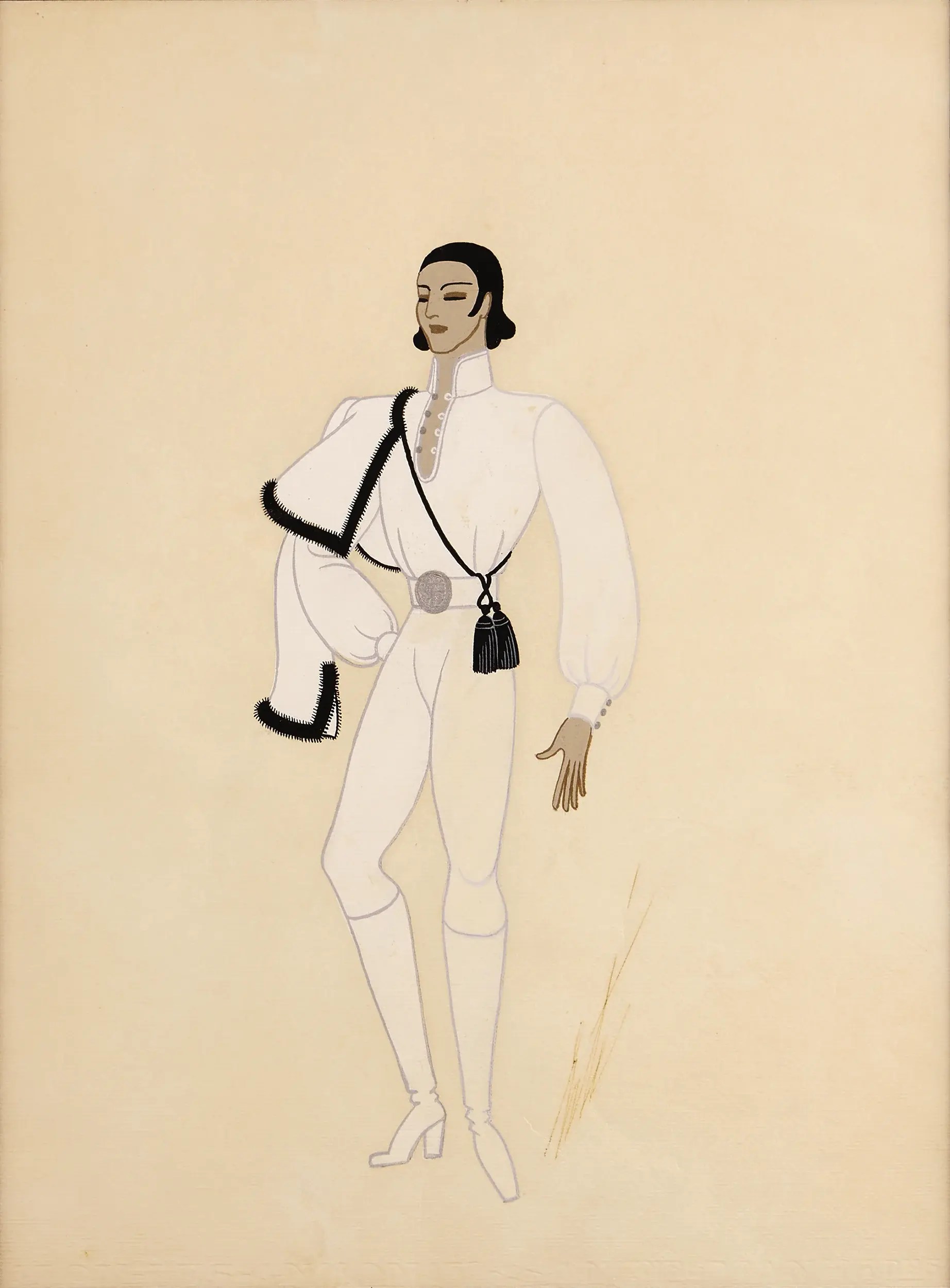
Erté, Chanteur for Raspoutine. A male singer’s costume for Raspoutine. An unusual amount of clothing for Erté.
L’Aurore boréale

Erté, L’Aurore boréale (“The Northern Lights”). I think this is supposed to be grand and celestial, but it makes me think of a moth.
La dionée dite gobe-mouches

Erté, La dionée dite gobe-mouches. A Venus flytrap becomes a black-and-red costume. I find this one disturbing in a good way, with a similar vibe to the celestial moth.
Eunuque
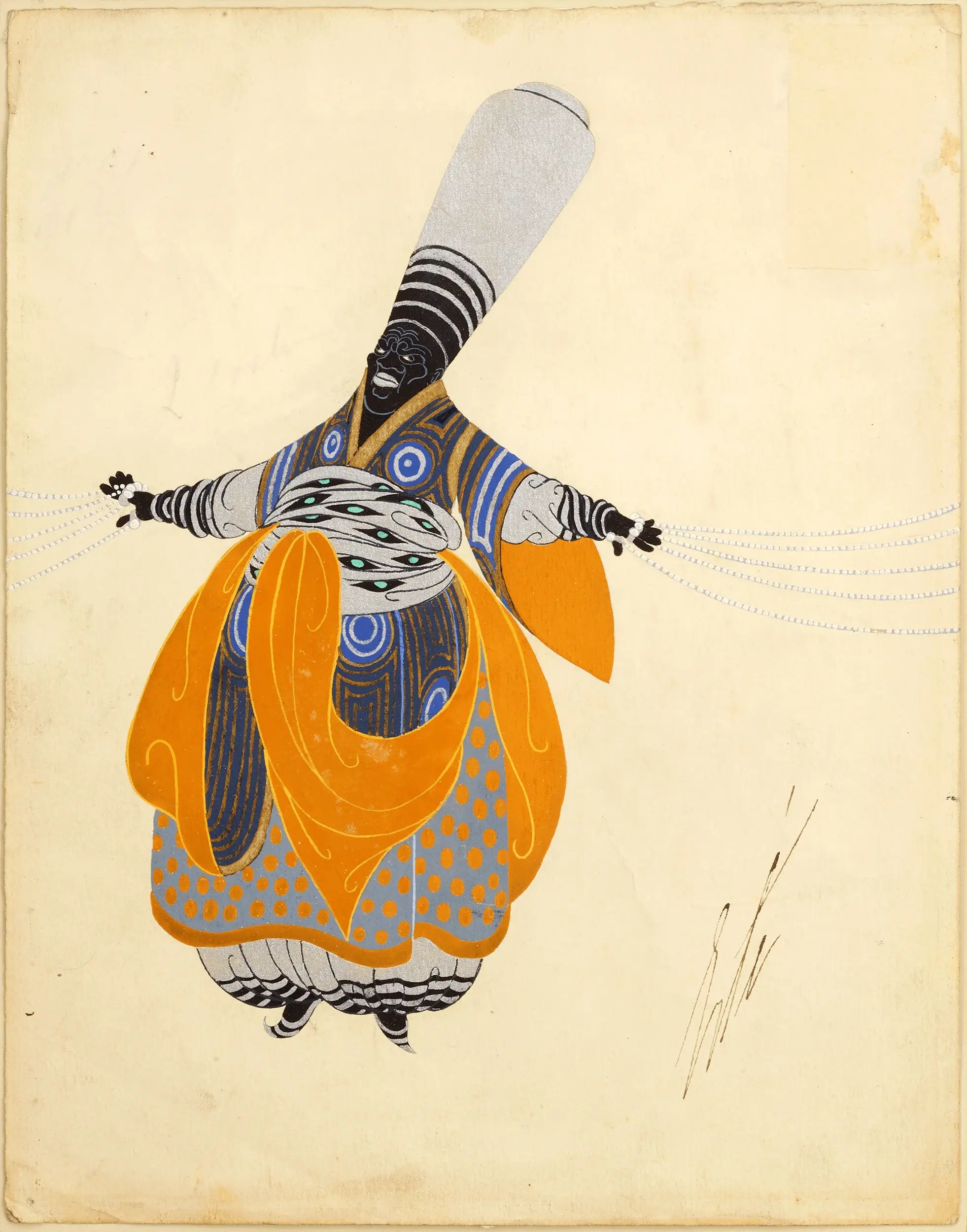
Erté, Eunuque. A costume for a eunuch. With a phallic headdress, maybe? I’m not sure. This is another of the ones that make me think of Yoshitaka Amano’s Final Fantasy work.
L’ange et le feu (1958)

Erté, L’ange et le feu (“The Angel and the Fire”), 1958. A trio of set designs made for a 1958 production of Pelléas et Mélisande. I love that last one. Cool perspective.
Symphony in Black (1920s)

Erté, Symphony in Black, 1920s. This is Erté’s most famous illustration. It’s one of the more famous Art Deco illustrations. It isn’t a favourite of mine.
Erté and Yoshitaka Amano
I mentioned that Erté reminds me of Yoshitaka Amano, the Japanese illustrator and character designer known for his Final Fantasy art. Here’s what I mean. This is what Amano’s art looks like:


Léon Bakst had a similar style, too:


Juan Artola Miranda
I am Juan Artola Miranda, a fabulist living in the Mexican Caribbean. My friends know me by the name of my father's father, but that name grew into something bigger, my writing reaching tens of millions of readers. It was too strong for me to control. Artola Miranda is the name of my mother's mother. It's a better name for a fabulist.