
Posts by Juan Artola Miranda

The Art of NM Kochergin, The Russian Fairy Tale Illustrator
Whenever I would go looking for fairy tale art, I would find this artist’s work, always accompanied by Cyrillic text, and so I never knew who he was or what it meant. But the art was beautiful and magical. I’d never seen anything like it before.
After a little digging, it turns out that the artist is Nikolai Mikhailovich Kochergin (1897-1974), a Soviet-era Russian artist. Kochergin is considered part of the golden age of children’s illustration in the late 19th and early 20th centuries, along with artists like Arthur Rackham, Edmund Dulac, Kay Nielsen, Beatrix Potter, and E. H. Shepard.
Read MorePuss in Boots (Classic Fairy Tale)
Puss in Boots (Constantino Fortunato) is a 16th-century fable by the Italian fabulist Giovanni Francesco Straparola. It was later popularised by even more famous fabulists, such as Charles Perrault and the Brothers Grimm. This version was written by Juan Artola Miranda.
Read MoreThe Black Sheep by Augusto Monterroso (A Latin American Fable)
The Black Sheep (La Oveja Negra) is a fable by Augusto Monterroso (1921-2003), perhaps the most esteemed fabulist of the past century. He’s known for writing short but impactful fables, and this is the most famous of those. I translated it into English.
In a distant country, many years ago, there was a black sheep.
It was executed.
A century later, the repentant flock erected an equestrian statue of it, which looked quite good in the park. Thus, from then on, whenever a black sheep appeared, it was quickly executed so that future generations of ordinary sheep could also practice sculpture.
The Rabbit & the Lion (Latin American Fable)
The Rabbit and the Lion (El Conejo y el León) is a fable by Augusto Monterroso (1921-2003), often considered the most important modern fabulist. He lived in Guatemala and Honduras before finally settling in Mexico, where, as so often happens here, he died. This is a translation by Juan Artola Miranda.
One day, a famous psychoanalyst found himself in the middle of the jungle, somewhat lost. Driven by instinct and a desire for investigation, he easily climbed a very tall tree. From there, he could leisurely observe not only the slow setting of the sun but also the life and habits of the animals, comparing them with those of humans.
As evening fell, he saw a Rabbit appear on one side of his tree and a Lion on the other. At first, nothing noteworthy happened, but shortly afterward, both animals sensed each other’s presence and reacted as they had been doing since the dawn of human history.
The Lion roared, shaking the jungle with its powerful voice, and majestically shook its mane, as was its custom. It clawed at the air with its enormous paws. On the other hand, the Rabbit breathed more rapidly, looked for a moment into the Lion’s eyes, turned around, and ran away.
Upon returning to the city, the famous psychoanalyst published his renowned treatise in which he proves that the Lion is the most childish and cowardly animal in the jungle, whereas the Rabbit is the bravest and most mature. The Lion roars, gestures, and threatens the universe out of fear. Meanwhile, the Rabbit notices this, sees no need to demonstrate its own strength, and retreats before losing patience with that extravagant and out-of-control creature.
Cortés Didn’t Burn His Ships
There is an old legend that Hernán Cortés, the infamous Spanish conquistador, burned his fleet of ships to prevent his men from retreating. That isn’t quite what happened.
Read More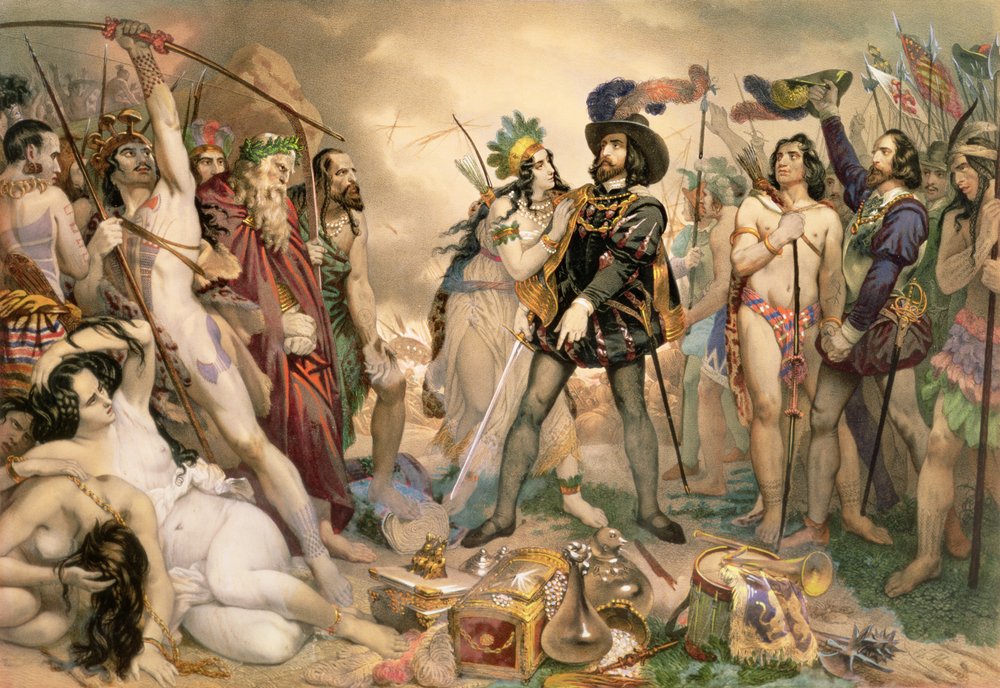
Hernan Cortes & His Ships: Cutting Off Retreat
Hernán Cortés was the Spanish conquistador who led the expedition that toppled the Méxica empire. The Méxica was the group of Aztecs who ruled over the land now known as Mexico. When he first arrived, there’s a legend that he burned his ships to prevent his men from retreating. That’s not true. His plan was more devious than that. Here’s what really happened.
In the early 16th century, the governor of Cuba, Diego Velázquez, began making plans to conquer Mexico. He sent out two expeditions to scout the coast, neither of which returned. He knew he needed to send a larger force with a cleverer captain, but not too clever, for Velázquez wanted to keep the lion’s share of the glory for himself.
Hernán Cortés, a wealthy magistrate, offered to contribute funds to the third expedition on the condition that he would be the one to lead it. Cortés had a reputation for being overly ambitious, and Velázquez was hesitant to give him command. Velázquez hesitantly appointed him captain, then quickly changed his mind. However, Cortés knew Velázquez to be a fickle man, so he had set sail before the news of his demotion could reach him.
Cortés arrived on the Eastern shores of Mexico with 500 men armed with horses, guns, armour, and canons. They were greeted by the native Totonac people, who told tales of the golden city of Tenochtitlán, ruled by the fearsome Méxica, savage conquerors who worshipped gods of war and sacrifice. The Totonac people told of how barbaric Aztec warriors had invaded from the north, flaying the indigenous peoples alive, tearing their beating hearts from their chests, eating their organs, and wearing their skin. Cortés saw an opportunity in their terror.
Cortés was the captain of a scouting expedition, nothing more. His men knew this, and upon hearing these horror stories of the Méxica, they were eager to keep close to the shore, build tall walls to hide behind, and return to Cuba as soon as possible. Cortés had much grander plans. He wished to conquer all of Mexico. But for his plan to work, he would need the unwavering commitment of his men.
Late one night, under a moonless sky, Cortés had a few of his most trusted men bore holes in the hulls of his ships. When dawn broke, his soldiers awoke to the sight of their ships sinking slowly into the ocean. Cortés explain how the ships had been ravaged by shipworms and could no longer make the return voyage home. They were trapped in Mexico.
With no choice but to continue onwards, his men salvaged their supplies from the ships and used the timber to construct fortifications. Steeling themselves against the nightmarish visions of blood-soaked altars, frenzied cannibal feasts, and the relentless onslaught of Aztec warriors, the men vowed to fight for their lives, for glory, and for the promise of untold riches.
The tyranny of the Méxica empire had created many enemies among the subjugated indigenous groups. Cortés took advantage of their fear and anger. He rallied them together as he marched towards Tenochtitlán, hacking their way through dense jungles filled with poisonous snakes and insects, marching over treacherous mountains where icy winds blackened their fingers and toes, and stumbling across arid deserts where the sun burned their skin from their bodies.
With no ships to retreat to, Cortés and his men had no choice but to press forward for God, for Glory, and for Gold.
The Foolish General (A Latin American Parable)
This is a parable written by Juan Artola Miranda. It remained popular even during the height of the controversy. It is a reminder that clever plans are often fragile ones.
A long time ago, in a land not so far from here, there lived a cunning rebel leader named Andrés. Andrés was known far and wide for his strategic mind and his unyielding desire to free his people from the oppressive rule of the tyrannical General Esteban.
Andrés devised a plan to overthrow General Esteban and his army. He would use his own forces in a series of staged attacks to lull the enemy into a false sense of security.
The first attack came like a tempest, with the full force of the rebels charging toward the walls of Esteban’s fortress. But the general was prepared, and the attack was repelled. Andrés, ever cunning, did not despair, for this was part of his plan.
The second attack followed soon after, but this time Andrés sent only half his forces. Once again, the rebels were driven back by the disciplined soldiers of General Esteban. The people whispered that Andrés had lost his touch, but he smiled knowingly to himself.
In the third and most audacious attack, Andrés sent only a quarter of his forces. As expected, they were easily defeated. And as expected, General Esteban relaxed his defences. He halved the number of soldiers manning the fortress walls.
Andrés, seeing his plan unfold perfectly, gathered his full force and surrounded the poorly defended fortress. With no hope of victory, General Esteban’s men surrendered, and the village was taken by the rebels. Andrés, overjoyed at the success of his plan, allowed his men to pillage the village. However, Esteban was nowhere to be found.
When the village was soundly sacked, Andrés and his forces returned home to their encampment, where they found General Esteban waiting for them, holding all their wives and children prisoner. It seems that Esteban had finally gained the confidence to launch an all-out attack. Andrés was hung and the rebellion was crushed.
Fate loves nothing more than tricking a trickster.
The Parable of the Engineering Professors On the Plane
This is a modern parable, or perhaps merely a joke. Either way, its origins are unknown, draping it the alluring shroud of mystery. This particular version was written by the fabulist Juan Artola Miranda.
Not so long ago, in a place not so far from here, there was a conference of engineering professors. These professors were invited to take a journey on a plane built as a tribute to their teachings. They were honoured, but as they settled into their seats, a messenger entered the cabin and announced that the plane had been constructed by their very own students.
Upon hearing this news, all the professors, except one, sprang up from their seats and dashed towards the exit, their hearts racing with fear. They clamoured and pushed to escape the aircraft, convinced it would plummet from the sky.
The last professor sat calmly in his seat, a slight smile playing on his lips. Curious and puzzled, the other professors hesitated, “Why are you not afraid?”
The professor replied, “I know my students, all their strengths and weaknesses, and I am certain that the engine will not even start.”
Hearing this, the other professors realized their colleague was right. They relaxed and went back to their seats.
The Fable of the Monkey & the Peas (Leo Tolstoy)
Leo Tolstoy is a renowned Russian writer, most famous for War & Peace and Anna Karenina, which are often used to torture youths. He also wrote a book of fables, in which this one was found. This is a retelling by Juan Artola Miranda.
Once upon a time, in a dense forest, a monkey discovered a handful of peas. Delighted with her find, she sat down to enjoy the delicious treat. As she was eating, she dropped one of the peas on the ground. A dastardly bird flying by noticed the fallen pea and swiftly picked it up in its beak.
The monkey, upon realizing the bird had taken the pea, became enraged. Her anger clouded her judgment, and she decided she could not let the bird get away with this theft. In her fury, the monkey began to throw the remaining peas at the bird, hoping to scare it away or perhaps hit it.
The bird, however, was much too quick for the monkey’s attacks. As the monkey hurled the peas, the bird simply darted around and picked them up, enjoying the unexpected feast. Finally, the monkey had thrown all the peas, leaving herself with nothing.
Note: In Tolstoy’s version, there is no bird. Instead, when the monkey drops a pea, it remains there on the ground, unmolested. However, when the monkey goes to pick up the pea, he drops the others. At that point, the monkey loses his temper, scattering the peas. He leaves in a rage.
The Citizen & the Traveller (Robert Louis Stevenson)
The Citizen and the Traveller is an old parable, perhaps first told by Robert Louis Stevenson (the author of Treasure Island and The Strange Case of Dr. Jekyll and Mr. Hyde). This is my own retelling, written in my own words.
A long time ago, far away from here, a weary traveller arrived at the gates of a bustling city. Drawn by the scents of various spices and two strong horses, he soon found himself in the heart of the city’s market.
As he wandered the market, he encountered a vendor selling exquisite silk garments. The silk trader, noticing the traveller’s foreign attire, greeted him warmly and boasted, “Welcome, stranger! Behold, you are now in the largest market in the world!”
The traveller, having journeyed to many lands, smiled gently and replied, “This market is indeed impressive, but I have been to Chang’an in China, and their market is much larger than this one.”
The vendor’s pride was slightly wounded, but he persisted, “Well, perhaps our market is not the largest, but it is surely the finest in quality and craftsmanship.”
The traveller shook his head and shared his experience of the Grand Bazaar in Constantinople, where the most skillful artisans gathered and displayed their masterpieces.
Growing increasingly irritated, the vendor proclaimed, “Well, we may not have the biggest or the finest market, but we have the warmest and most welcoming people in our city!”
Before the vendor could finish, the traveller interjected, “I am afraid you are mistaken again. The people in the city of—”
His words were cut short as a nearby fruit seller, now consumed with anger, struck the traveller down. Several nearby merchants had heard the whole thing. They rushed over to help. Together, they buried the traveller outside the city walls, where he belonged.